How Powder Puffs Led to the Compact Case
Learn how the powder puff to compact case shift brought powder, an applicator, and a mirror together for a more contained touch-up routine.
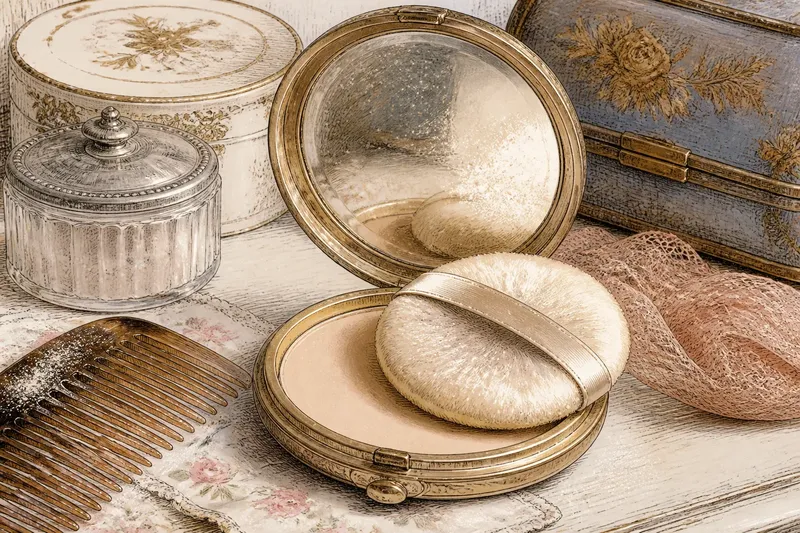
A powder puff tucked into a handbag can leave dust on a comb or the lining. The powder puff to compact case shift addressed that everyday problem by bringing powder and an applicator into a more contained package, though designs varied across makers and periods.
How did loose powder and a puff work together?
Loose face powder was kept in containers such as jars or boxes, while a soft puff picked up and applied it. At home, the container and puff could sit together on a dressing table. Carrying them meant keeping track of separate items and taking care that the powder container stayed closed.
Designs were not uniform: some containers offered ways to store or cover the puff, while others required the user to manage the applicator separately. The general design problem was consistent—powder had to be carried without spilling, and the tool needed to stay accessible.
What changed when powder moved into a compact?
A compact could bring pressed powder, an applicator, and sometimes a mirror into one case. The hinged design made it possible to open the case, pick up powder from the cake, apply it, and close the case again. Not every compact included the same parts, and the arrangement depended on the particular design.
Pressing powder into a cake changed how it was handled: the product was less free to shift than loose powder, but it could still crack or leave crumbs. A puff could still collect residue, so the compact was contained rather than maintenance-free.
Why did mirrors and applicators matter?
A mirror let someone check placement while applying powder away from a dressing table. A puff suited picking up product from a pressed surface; other designs could use different applicators. The tool, powder, and case had to work together, and the best arrangement depended on the product and intended use.
Adding a mirror also created practical design concerns. Powder dust could cloud the reflective surface, and a loose applicator could rub against it. Case makers could address these issues in different ways, such as separating interior spaces or using a cover. Ornament might make a case attractive, but its hinge, clasp, and layout determined how it worked in a bag.
What do people ask about powder puffs and compact cases?
Why put powder in a pressed cake?
A pressed cake was less likely than loose powder to shift around inside a closed case. It also let an applicator pick up product from within the compact.
Was a compact always for face powder?
No. Compact designs and contents varied, and some cases could hold cosmetics other than face powder. The shape and compartments determined what a particular case could carry.
How was a puff different from a sponge?
A puff was generally a soft fabric applicator used to pick up and press powder onto the skin. A sponge has a different texture and is suited to products designed for that kind of applicator.
What did a mirror add to a touch-up?
It let the user see where product was going without seeking a separate reflective surface. That made the case useful for checking makeup, though it also meant the mirror needed protection from dust and contact.
How can you read the design of a powder compact?
Look at the interior as a sequence: where the product sits, where the applicator rests, and whether the mirror can stay clean when the case closes. These details explain how the object was meant to be handled without assuming that every compact followed one timeline or layout.
Say you are examining an invented vintage case with a pressed powder pan, a puff resting directly on the powder, and a mirror on the lid. First, note that the puff can touch the mirror when the lid closes; next, check whether a divider or protective cover is present. If neither separates them, the likely tradeoff is compact storage at the cost of a mirror that may collect powder. The case still combines several tasks, but its layout leaves one practical weakness visible.
For a quick reading, check these features and choose what each one suggests:
- Observe whether the case has a powder pan; if it does, the design accommodates a product held in that space, but if it does not, treat it as a different kind of compact or accessory.
- Observe whether the powder is loose or pressed; if it is pressed, the applicator can pick up product from the cake, but if it is loose, look for a sifter or another way to limit spills.
- Observe where the puff rests; if it sits apart from the mirror, the layout helps keep the surfaces separate, but if it touches the mirror, expect more powder transfer and handle the case accordingly.
- Observe whether the lid has a mirror; if it does, the case supports a visual check during application, but if it does not, a separate mirror is needed for that task.
- Observe the clasp; if it closes securely, the case is better suited to carrying, but if it feels loose or fails to catch, keep it in a protected container rather than loose in a bag.
- Observe whether the applicator is present and fits its space; if it is, the case retains its intended tool, but if it is missing or ill-fitting, identify a suitable replacement before using the compact.
The powder puff to compact case story is best read as a broad design pattern, not a single, uniform progression. Loose powder containers, pressed cakes, mirrors, and applicators appeared in varied arrangements; examining how each object stores product and organizes a touch-up reveals what its design makes easy—and what it leaves for the user to manage.